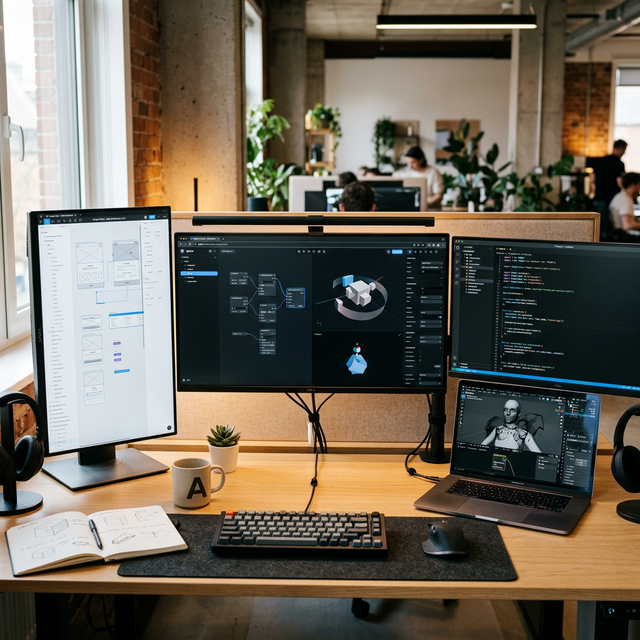
The demand for 3D immersive websites has exploded, but finding the right designer remains a significant challenge. Unlike traditional web design, 3D web work sits at the intersection of visual design, 3D modeling, creative coding, and performance engineering. Not every designer who claims expertise in this space can actually deliver a production-ready product.
Define Your Project Scope First
Before reaching out to any designer, get clear on what you actually need. The spectrum of '3D web design' is enormous, ranging from a simple Spline embed on a landing page to a fully custom Three.js experience with shader effects and physics simulations. Your budget, timeline, and performance requirements will all depend on where your project falls on this spectrum.
- ●Simple 3D elements (Spline embeds, animated icons): $2,000 to $5,000
- ●Interactive landing pages with custom 3D scenes: $5,000 to $15,000
- ●Full immersive experiences with multiple 3D environments: $15,000 to $50,000+
- ●WebGL product configurators with real-time rendering: $20,000 to $80,000+
Evaluating Technical Skills
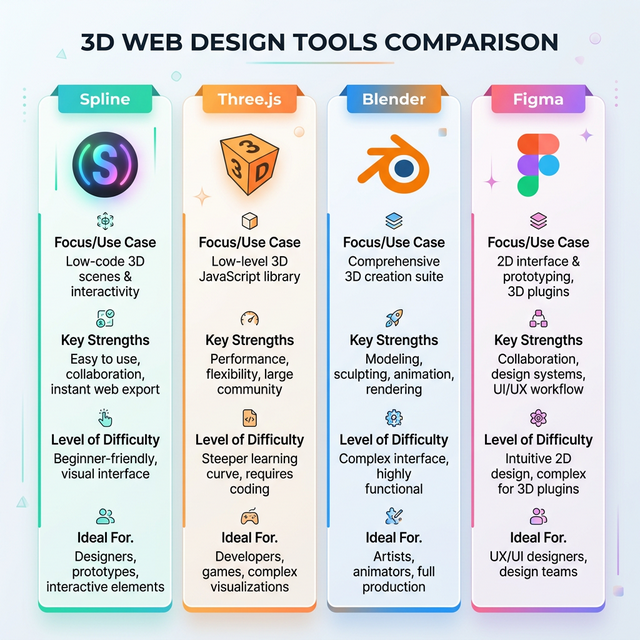
The 3D web design ecosystem includes several major tools, and each designer's toolchain tells you a lot about their capabilities. Spline is excellent for rapid prototyping and designs that need to look good quickly. Three.js and React Three Fiber (R3F) offer unlimited customization for complex, performance-critical experiences. Blender is essential for custom 3D modeling, while tools like Figma and After Effects handle the 2D design and motion design layers.
Ask potential designers about their optimization workflow. A good 3D web designer should be able to explain how they handle model compression (DRACO/meshopt), texture optimization (KTX2/Basis), lazy loading strategies, and how they balance visual quality with Core Web Vitals performance.
Portfolio Red Flags and Green Flags
When reviewing a designer's portfolio, look beyond the visual wow factor. Open their sites on a mobile device. Do they work? Check the loading speed on PageSpeed Insights. Are the 3D elements accessible with proper fallbacks? A beautiful portfolio that's slow and breaks on mobile is a red flag.
"A designer's portfolio doesn't just show what they can build. It shows how they think about user experience. If their own website is slow or inaccessible, imagine what they'll deliver for your brand."
Priyansh Tyagi
Communication and Process
The best 3D web designers have a structured process: discovery → wireframing → 3D prototyping → development → optimization → deployment. They should be able to show you deliverables at each stage, not just a final product. Ask about their revision process, how they handle feedback, and what platforms they deploy to.
Where to Find 3D Web Designers
Platforms like Contra, Awwwards, and Dribbble are great starting points. Look for designers who have been featured in industry publications or who have won design awards. Personal referrals from other businesses who've invested in immersive web experiences are invaluable.
Ultimately, the right 3D web designer is someone who combines technical mastery with strong communication and a genuine understanding of your brand. Take the time to evaluate multiple candidates, review their process documentation, and have a detailed conversation about your project before committing.